Showing posts with label Convent. Show all posts

Thursday, January 29, 2015

Secret Confessions of a Former Nun

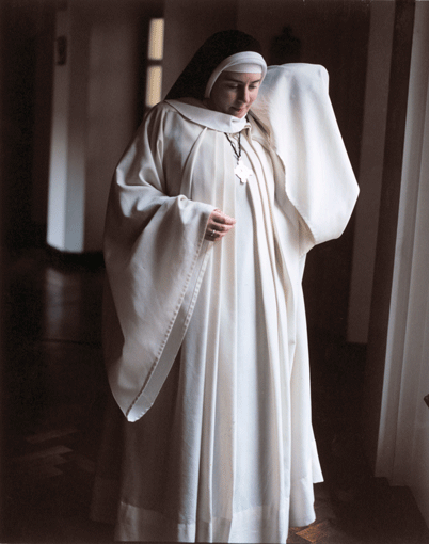
I have a confession to make: I am terrified of nuns. How strange! I don't like seeing them, I avoid meeting them, and I am terrified of speaking to them. It's not because I am unfamiliar with them; rather the opposite is true. I am very familiar with nuns. How could I not be? I spent two years in a contemplative convent. I became a novice. I wore a habit. I joined in with every aspect of convent life.

All this should make me comfortable with nuns, right? They are holy people, women set apart by God for a special calling. But my dreams are filled with women, who although wearing habits, act any way but holy. I have nightmares of critical sisters, watching me, demanding things of me, punishing me. And I wake in terror, roll over to see my husband peacefully asleep. And I realise I am free of the nuns, and have been for nine years. I am not a nun. And I never have to go back. No longer am I under the rules of a convent; I am free.

I have escaped in every way. Except in my head.

How awful to describe my exit from a convent as an escape! Surely I am being hyperbolic? To answer that, I must take you back with me to when I was 18, a confused but idealistic teenager ready to give her life for God.

I remember being 18. I was, to put it kindly, a bit of a mess. I was aimless, not sure of my path in life. I guess, really, I wasn't that different to hundreds of other teenagers. But I felt unique among my peers. They all seemed happy, busy studying hard, learning to drive, doing all those things that normal teenagers do. I never seemed able to concentrate on any one thing for long. I was also stressed at home, as I felt I was falling short of my mum's expectations (something I discussed in my last post).

But I was also a very religious teen. And it entered my head that maybe I felt so out of place because I wasn't truly in my right place. Maybe I wasn't meant to be at home in the world at all? I knew religious life was a huge sacrifice, but the more I thought about it, the more I was comfortable with the idea. Surely such a sacrifice was more than compensated for if I felt I belonged?

So I started searching. I won't tell you where I went, but eventually I found a convent of contemplative nuns. They were, to put it mildly, very traditional. And I went to stay there for a week. They seemed like lovely people, from what I could gather from observing a set of silent people. The beautiful habits, the wonderful singing of the Psalms, the grace of the nuns' demeanors and the silent worship of the Eucharist captured my imagination. I wanted to be a part of it.

I left home and went there, fully expecting to stay forever. I gave away all my belongings, said my goodbyes, and was installed into a little brick cell that was to be my home for the next two years. It had bars on the window. But I wasn't put off. I was ready to give my life for God, and nothing was going to stop me! But before too long, although my stubborn nature never gave up the idea of living as a nun, I began to make some awful discoveries, both about myself, and about the culture of the people I was living with. 

Firstly, myself. I was a difficult teen when I was at home, and I was not a magically new person in the convent. I struggled with myself constantly. I was homesick, then crazily manic, then suicidally depressed. I was, as I have said in other posts, grappling with the realities of an emerging mental illness. Not that i realised it. It seemed to me that I was just a bad person. And as I constantly found myself in a position of having having to apologise for myself, of having to push myself to do things that my nature seemed to be rebelling against, I began to hate the person I was.

Maybe it was because I was so difficult to be around, but I never felt well-liked among the other nuns. Every time I failed to obey the rules, every time I had to apologise for my failings, I saw them looking at me in disappointment, and, in some cases, irritation. It hurt. I had to realise that they were people too. The "holy nuns" were just people, trying to do their best, but not always able to cope with the moody, impulsive, tearful teen in their midst.

The rules didn't help either. The incredibly strict rule of life had me up from 5 in the morning to late at night. I was constantly exhausted. So were the other nuns. The rule of silence meant I could never talk through what was going on in my head, but was instead left to stew in my own emotions. And we had to work so hard! In the last part of my time at the convent, I was made cook. Imagine a 19 year old trying to sort out meals for 12 people everyday! I saw other sisters get far lighter duties. Maybe it was a mark of faith in me that they thought I was capable of such a huge task, but to me, it felt like a punishment.

And punishments came to me thick and fast. The nuns had a custom called the Chapter of Faults. Once a week, you were meant to kneel in front of all the other sisters and confess all the times you had broken the rules. Then you were given a penance to do. I always had a grocery list of faults. Running, talking, leaving prayer early... I was always confessing something. And it felt like a humiliation every time as I brought everyone's attention again to my faults as a nun.

I was so lonely there. The only contact I had with people was through letters ad the brief visits of my family. None of my friends ever came to visit. And even with those moments of contact, I felt isolated. I felt I had to present an image to everyone of someone who was well-adjusted, happy, content. When I wanted to reach out, I didn't know how to. 

Of course, there were good times. I learnt a lot. I enjoyed studying, singing and garden work (although I was awful at it!). I gained the reputation of being a bit of a prankster. But over it all was the growing realisation that I wasn't developing into the person the convent wanted, but rather I was collapsing into an emotional wreck.

It wasn't my choice to leave the convent. In my stubborness, it took the Mother General of the convent to make me leave. I felt I had failed. And I felt rejected personally by the convent. They never contacted me again after I left. They never wanted to see if I was alright, if I survived as a person. Of course, they had no obligation to, but after directing my life for two years, it would have been nice had they shown some interest in how I was doing.

After I left, I agonised for a long time over whether I should go back. Was it something I needed to do, or was I forcing myself into a hole that didn't fit? When I was diagnosed with bipolar disorder, I got my answer. They didn't accept mentally ill sisters. So I was able to get on with my life, facing the challenges of a new life sentence. I didn't need to bear it alone for long, as well. I met my husband, and a new range of opportunities and experiences opened up for me.

But I still dream of the nuns. They are in my head. I have flashbacks, too, sudden memories that drag me right back to my time in the convent. And in those memories, in those dreams, I am 18 again. Frightened, confused and alone, while struggling to cope with a new and unforgiving environment. And when I do that, I cry.

Maybe I will be able to lessen the impact of those memories. Time hasn't seemed to dull them. I am going to go to counselling, to try to do what I was never able to do in the convent - talk freely and honestly about my experiences and feelings. In the meantime, I am afraid of nuns. Not of them personally, but of what they bring up for me. 

I hope for a day when I can see nuns and not feel this way. I long for a time when I will finally be free.


Thursday, March 8, 2012

Soldier of Christ


Sometimes Catholic religious compare themselves to an army. They call themselves "Soldiers of Christ". In their opinion, they are fighting against the forces of evil, in groups, training and sacrificing themselves for the greater good.

And it is true that the religious are disciplined, strong, well-trained and obedient, capable of great sacrifice, just as a good soldier is. There are many parallels that can be made between the two. But, having lived as a religious for two years, I have seen more of religious life than most people, and I can draw some more interesting parallels between religious and soldiers.

They Break You Down, Then Build You Back Up

It's no secret that the army recruitment training can be tough. It's been a stated objective that the officers training the recruits aim to completely break them, before building them back up into the desired soldiers. And it's pretty clear why. A soldier needs to be part of a whole; he needs to be instantly, unquestioningly obedient, loyal, brave and uncomplaining. Any soldier without the physical and mental toughness born of enduring their training would not last long in a war zone.

It's exactly the same for religious. I'm going to refer to "nuns" and "she/her", as this is from my personal experience, but I am sure this can extend to male religious as well.

A nun's probationary period, known variously as a "postulancy", "aspirancy" or "novitiate", can be horrendously difficult to endure. At least in the convent where I was based, there was little lee-way given to new sisters. New sisters were expected to quickly learn and follow the rules; this, coupled with a demanding physical schedule, could be exhausting. With little sympathy from the older sisters, new sisters would be expected to sink or swim under their own power.

It's hard to see why the experience should be so hard, but the effect was very similar to a soldier's training. Sisters would be broken physically and mentally, and if they survived, would be re-trained to think and act as a religious. While a nun may never need to enter a war-zone, the confines of religious life, coupled with their long days and rigorous schedule, requires a certain mindset and physical toughness. The probationary period is expected to produce that, whilst weeding out  candidates who couldn't or didn't want to make such a sacrifice.

I remember being broken in so many ways during my time in the convent. From kneeling to sisters when I broke the rules, to giving up personal gifts to the convent, to being denied phonecalls to my family - they all worked to break me down. The idea was that I would become selfless, identifying myself with the convent. But, at least for me, it didn't work. All it did was hurt, leaving me sick and broken.

They Both Value Obedience Over Individuality

Soldiers are not known for their individuality. They give up much of it when they first join, being addressed as "Private", rather than by their name; wearing uniforms; eating, sleeping, training and recreating in communal, utilitarian areas; even marching in uniform rows. Soldiers who stand out either do so because they failed to conform to expectations, or because they went over and above expectations in performing their duties. The great majority of soldiers are a uniform group, all with the same physical abilities and mental mindset.

Nuns are very similar. Of course, there are the habits, which turn every sister into a perambulating sheet of dull cloth, but there are the names too. Depending on the order, every person who goes into religious life can expect to be referred to as "sister", and even give up their given name for a new one. For example, my name is Felicity, but when I was in the convent I was referred to as "Sister Mary Raphael".

All sisters are expected to live alike, with no one having any privileges or possessions that cannot be shared with all the other sisters. Even more than soldiers, nuns are taught to hold everything in common, and to move, act and think alike. They become part of a whole, and are encouraged to disregard their own needs and wants in favour of the entire group.

I was quite ok with a lot of the methods used to make me a part of the convent whole. I didn't mind giving up my possessions, or sharing food, rooms and books. I didn't even mind being called by a religious name. For me, the problem began when I was led to believe I should give up everything, even my own well-being, in order to better serve the convent. I was ready to do so, and tried my best, but in the end, when I was ill and asked to leave, I felt rejected, as if I had given everything, and received no gratitude in return.

 They Are Open To Abuse

I'm not going to make this into a post about the various failings of soldiers or religious. Every organisation is open to abuse of the system, and for every example of power abused, there is hundreds of examples of the organisations working. If an adult chooses to take one of these paths, they should be mature enough to understand the pitfalls and dangers they are risking. Soldiers know they risk injury and death serving their country, and nuns should know they risk isolation and physical and mental exhaustion serving their God.

What interests me is the way soldiers and nuns both value their loyalty over their own well-being. From the before-mentioned training, both are conditioned to value the good of the whole over that of the individual. They are taught to be obedient and selfless. The problem can be if the organisation that they have been trained to be loyal to fails in its responsibility to the individuals making it up.

Even after I left the convent, I was very reluctant to discuss the convent. I used to deflect questions with humour, and tell quirky stories, rather than reveal what I had truly been feeling over the time I lived there. I think now that it was because I still felt this loyalty to the convent. Even though I had been rejected from it, even though I had no ties there anymore, and even though it may have hurt me, I couldn't bring myself to criticise it.

These days, I think of my time at the convent was as character-building as a stint in the army - with most of the same pitfalls. I may not have gone to a war zone, or developed PTSD, or been injured in the line of duty, but I bear my own scars of serving, even if for only a couple of years, as one of the Soldiers of Christ. The convent was not perfect, but I learnt many lessons. Rather more of them were learnt the hard way than I would have liked, but still, I have experiences and memories that will shape me forever. And it taught me the ultimate parallel between the army and religious:

Being a soldier is hard. One may asked to make the ultimate sacrifice for one's country. But being a Soldier of Christ is harder, as they aim to make every nun make the ultimate sacrifice for their God.

Wednesday, February 22, 2012

Who Am I, And To What End Do I Live?


I think I became a stoic by accident at the age of twelve. I had heard of the philosophical views of the Stoics (I was quite a reader), yet I didn't decide to live like that. It just happened. My brother died one day after birth, and I needed to survive somehow. While most of my family went through the natural process of grieving and healing, with the exception of my siblings who were too young to understand, I wanted to be strong. I wanted to be dependable, in order to help my family. So I denied my grief, squashed my emotions down as best a 12 year old can, and plodded on, determined to be a good, helpful child.

My family are devoted Catholics, and I know that their faith was, if shaken at first, only deepened by the experience, as they worked through their shock and grief to find healing in prayer. Grief tends to do that to people; either they find greater meaning in their faith through it, or they abandon faith altogether. As for me, I began thinking about God differently. I didn't ever doubt He was there, nor did I feel tempted to turn my back on Him. Instead, I told myself God did everything for the best. I didn't feel loved by Him, so much as I felt I needed to be strong to endure whatever else He had to throw at me. I gave up on trying to make sense of the whole situation, and just concentrated on enduring.

As I grew older, I ceased to feel as if I was loved by God and others just for who I was. Instead, my belief that God was distant led me to believe that if I could just become virtuous enough, maybe He would come to love me. I guess I thought I could achieve peace through practising religion. So I would pray and try to conform my life exactly to the rules of the Catholic Church. I became set on obedience, and I was ready to sacrifice whatever it took. I think I began to consider myself as more of a thing than a person, something that could achieve recognition through successes, but that had no intrinsic value of its own. 

I've mentioned often before that I found my emotions a hindrance and an obstacle as I grew out of being a teenager into young adulthood. I found negative emotions driving me to do things I logically didn't want to do. I perceived my emotions as being unwanted, a barrier between me and my ideal identity, that of an in-control, virtuous, rational woman. So I crushed them down. If I could have had them surgically removed, I think I would have. I prided myself on being unattached to physical things, and on having a clear and logical mind, and emotions just seemed like unnecessary baggage to carry around.

While I was in the convent, this desire to be emotionless, a person driven by logic and obedience, only seemed to be reinforced. I did my best to ignore the needs of my body and emotions, driving myself to the point of physical collapse in order to do everything prescribed by the convent Rule. I never considered that God might not want me to hurt myself in order to obey, but simply accepted the rigorous life as another God-given suffering to endure.

My body didn't really cope with the physical demands of religious life, but I took that as a necessary suffering. I used to look at one sister who had very plain signs of a mental illness, and I would think that I could accept any physical suffering, so long as my mind never went. I was absolutely fine with the idea of physical disability or death, but to lose my mind? I would think of my deceased grandmother, who eventually lost the ability to remember certain words, and who would forget to check the use-by dates on packets of food, and I was terrified I would one day lose control of my own mind.

It was ironic, therefore, that my desire to be a stoical, intellect-driven, successful person was shattered when my wayward emotions asserted themselves, pushing me into full-fledged mental illness. All my self-worth, based on my mastery of myself and on the achievement of religious life, was destroyed. I was asked to leave the convent, and worse, I found myself at home with no identity, no path in life, and a mind that was fractured with violent emotions I had seemingly no control over.


I think I spent some time just trying to endure this new pain. I felt broken, a shell of a person whose main purpose in life was simply to survive each coming day. Instead of being proud of my achievements, I slipped into self-hatred. I suppose I still thought of myself as a thing, and a thing that had out-lived its usefulness at that. I felt I had used up all of my energy and resources, only to be cast away because I couldn't live up to this perceived ideal. I was mentally sick, and I couldn't think clearly like I used to. I was battered by emotions I couldn't control, and therefore I found my physical self also out of control, one day full of boundless nervous energy, and the next day lethargic in the midst of deep depression. I had nothing left to take pride in, and I wanted to die.

There were two things that helped restore my self-worth. One was medical help, where through a combination of counselling and medication, I was shown how to gently control my emotions and to listen to what they were telling me. As I began to heal mentally, I found my mind growing clearer, and my health improving. On top of that, I found myself enjoying so many things I had simply ignored before; the sun as it dipped below the horizon of the ocean, the enjoyment of waking on a weekend to find that you can sleep in as long as you want, the fun of playing with a dog. Life was fuller, and I appreciated it so much more than I used to.

The second thing was the entry of love into my life. A nice young man got to know me, began to love me for who I was, not for what I could do, and decided he wanted to spend the rest of his life with me. I could hardly believe at first that he truly meant it. But he did, and the feeling of being wanted, just for who I was, was incredible.

I said before that I used to have an ideal identity. I wanted to be calm, rational and unaffected by emotions or physical needs. That identity was crushed when I became mentally sick. So who am I now? I'm still not sure, but I think if I want to be anything, I want to be a whole person. I want to be at peace within myself emotionally, physically and intellectually, able to reconcile those different facets of myself into one whole. I want to be someone who is able to enjoy both the emotional and physical enjoyment of eating cake, and the enjoyment of expanding my mind. I want to be happy with who I am, just as I am. I'd like to know that I am a worthwhile human being, not for anything I can do, but just for being me.

I doubt I can ever achieve all of this fully, but it is an ideal. In the meantime, I am quietly trying to start over a new life as a wife, and one day, maybe a mother. I bet there will be times when I love sight of who I want to be in the pressures of what I feel I should be doing, but hopefully I never forget for long.

Finally - God. I think it took the love of my husband to really drive home to me that God loves me. If Graham can care for me just as I am, broken and sick, then God must also do so. So I am much happier when I pray now. He is not just "up there", sending trials on us randomly. In fact, I can see that without trials such as my mental illness, I would never have grown past some very harmful attitudes and beliefs. So I guess I finally learnt the lesson my family learnt back when I was twelve - that God only gives us suffering we can bear in order to help us grow. It only took me around 10 years to learn it, but at least I got there in the end.

Wednesday, February 15, 2012

Human Contact


All humans need physical contact. Physical touch has been linked to all kinds of health benefits, from relieving depression, stress, anxiety and pain, to actually healing a person physically. Premature babies grow and thrive better when regularly touched, while it has been found that a baby left untouched will become very sick, or even die.


Growing up, I never had any problems absorbing the love of my family through physical contact. There were always siblings to be hugged and babies to be held. We would cuddle, wrestle and kiss.

This all changed when I left home for the convent. This very strict convent had all kinds of rules limiting communication, from a rule of silence, to separate rooms (or "cells") for the sisters to sleep in, to barriers between sisters in their pews, to a huge gate barring the sisters from the public. There were rules for everything, and most of them seem to have been designed to make each sister as invisible as possible.

I actually didn't mind being silent. I understood that to foster a prayerful environment, there had to be rules (even though I broke them often). I saw the individual cells as a privilege (I couldn't remember the last time I had a room just for me!). I didn't even mind the huge bars between me and the public, making me look like an animal on display.

What I found myself missing was human touch. Whether it was by accident or design, the sisters did not touch each other. No hugs, no touching hands or shoulders, nothing. I would go to bed at night and yearn even for the brief hug and kiss I used to get from my parents before bed. I didn't want much. Just a hug. And I never got one.

Eventually I realised the only time that the sisters ever touched was during Mass. The priest would invite us to exchange the Sign of Peace. Where most people would shake hands or kiss, we had a ritual. The junior nun would put her hands together in the gesture of prayer, and the senior nun would put her hands over them. Then both nuns would bow their heads as they exchanged the words: 

"Peace be with you." 

"And also with you."

It was all rather stylised. And it certainly didn't make me feel very loved. I felt lonely.

I left the convent, and in time, travelled across the country to Perth, Western Australia. Again, I found myself very lonely. This time, however, I was lucky enough to be part of a church community where physical touch was welcome. I remember going to prayer gatherings, where I had made friends with a little girl named Bridget. She used to ask permission from her mum, and run over to me to sit in my lap, hugging me while everyone sang.

This little girl made me feel so loved. I don't think she ever realised that often when I held her, I had tears in my eyes. The unconditional love, expressed through a hug, made me feel better when everything else in my life seemed to be going wrong.


Today, I have an inexhaustible source of comfort from my husband, who never seems fazed when I demand a hug. Sometimes I wonder if he knows why I prize our hugs so much, that because I had been deprived of human contact, I now crave touch. It probably doesn't matter. Graham gives amazing hugs, and I am able to just relax and enjoy the moments I spend in his arms.

My littlest sister Gemma-Rose is known in our family as the best kisser and hugger. I remember reading a story of my mother's where Gemma-Rose protested that she was dissatisfied with this role. She wanted to be bigger and have more responsibilities. I only wish I could let her know just how important her role really is, that everyone would find themselves sad and lonely without her enthusiastic hugs and smacking kisses.

Yes, Gemma-Rose has the most important role in the family. Because cuddles are all about sharing love, and that is the most important job of all.